
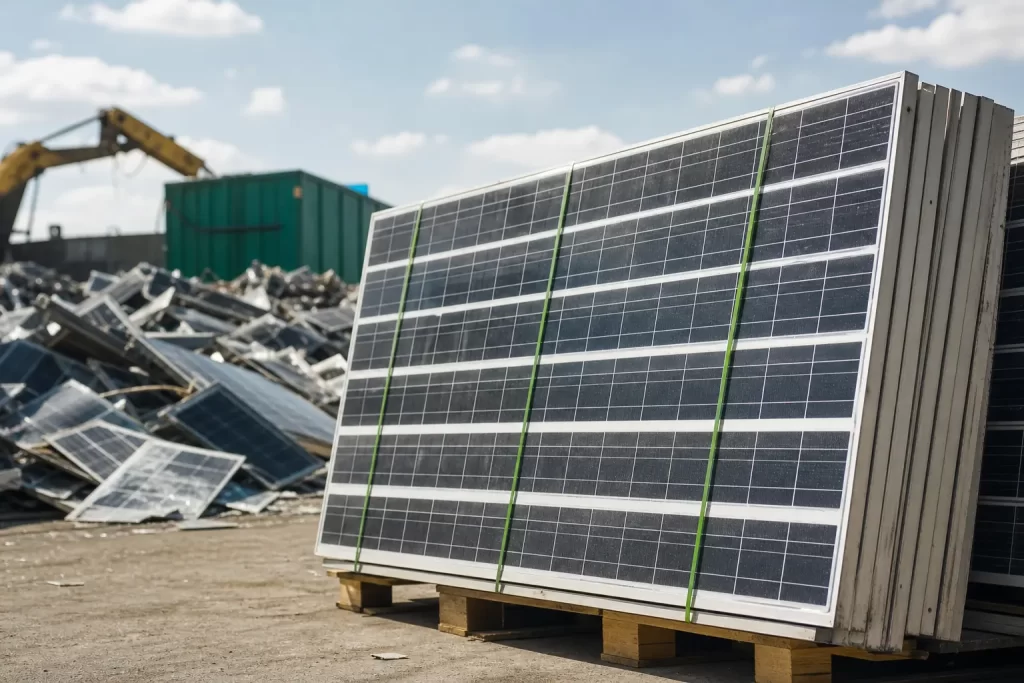
What happens to old solar panels in the United States?
Old solar panels in the United States typically follow four end-of-life routes: reuse and repair, manufacturer take-back or trade programs, materials recycling, and final disposal in permitted waste facilities. Reuse and repair means intact or repairable modules are retested, relabeled and redeployed as replacement modules or for lower-demand applications. Manufacturer take-back or trade programs return modules to the original supplier for refurbishment, reuse or onward recycling when available. Materials recycling breaks down modules to recover recoverable components; recycling participation depends on local access to specialized facilities. Final disposal is the last-resort path when no reuse or recycling option exists and must follow local solid-waste rules where permitted.
How are solar panels recycled and what materials are recovered?
Solar panel recycling uses mechanical, thermal and selective chemical or metallurgical separation steps to recover primary components such as glass, aluminum frames, copper wiring, semiconductor material from cells and polymer backsheet material. Mechanical separation removes the aluminum frame and junction box, shreds or cuts the laminate, and liberates glass and cell fragments. Thermal processing softens or decomposes polymer layers to free silicon cell pieces and attached metals. Chemical or metallurgical steps then treat cell fragments to reclaim silver, copper or silicon-rich material for further processing. Recyclers aim to recover clean glass, reusable aluminum and metals and to divert polymers from landfill, but the exact methods and recovery rates vary by facility and available technologies.
What should a solar-panel owner or installer do with an old or failing panel?
A solar-panel owner or installer should first determine whether the module is suitable for reuse or repair, then contact the original manufacturer or a certified e-waste recycler, and finally arrange for proper recycling or permitted disposal if no other option exists. Steps to follow include: 1) Inspect and test the module to confirm electrical output and visible damage; label defective modules and separate them from working inventory. 2) Check warranty terms and any manufacturer take-back, trade-in or refurbishment programs before pursuing other routes. 3) Locate a recycler that accepts photovoltaic modules or a licensed facility that handles e-waste; ask about accepted prep (frame removal, junction-box detachments) and required paperwork. 4) Safely decommission modules on site: isolate DC circuits, use appropriate lifting and handling to avoid glass breakage, and follow local transport rules. 5) Keep documentation of chain-of-custody when materials are recycled for regulatory or corporate reporting. Owners should also confirm local municipal rules on electronic waste and construction debris because landfill disposal may be restricted in some jurisdictions or require special permits.
Frequently asked questions
Can I put old solar panels in the regular trash?
Panels should not be placed in regular household trash; owners should check local regulations and instead pursue reuse, manufacturer take-back or certified e-waste recycling to ensure materials are recovered and hazardous constituents, if any, are managed properly.
Can solar panels be repaired or reused?
Many solar panels can be repaired or reused after testing; a qualified technician can identify modules suitable for reuse as replacements or for lower-power applications, and reused modules can extend lifespan while reducing waste.
How do I find a qualified recycler or take-back program?
Start by contacting the panel manufacturer for any take-back or refurbishment options, consult local solid-waste or e-waste authorities for certified recyclers, and verify facility acceptance policies and required preparation steps before transport.
Contact Compact Solar about your camera, wholesale order or own-brand project.