
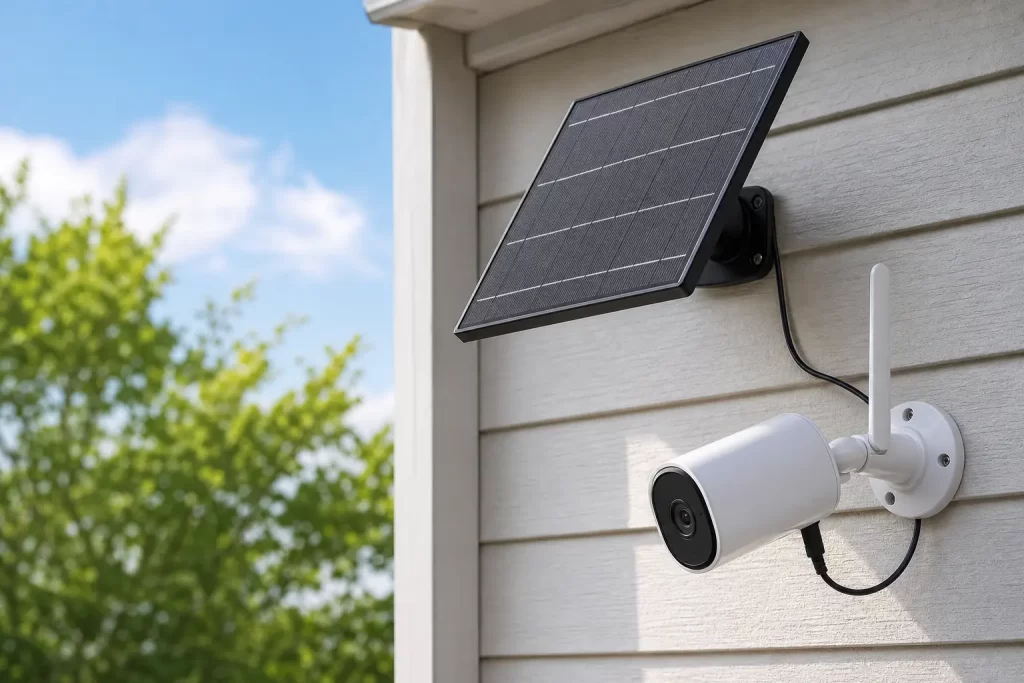
Plug-In Solar Kits: What They Include, Where They Fit and What to Compare
What does a plug-in solar kit do, and how does it work?
Plug-in solar kits are compact solar panel assemblies sized from 2W to 70W that harvest sunlight and either power low-voltage electronics directly via USB-C, Micro-USB or DC outputs or store energy in an integrated battery for later use. They reduce battery swaps for security cameras, trail cameras and IoT sensors by combining a panel, a connector cable and often a simple charge controller into a single, low-maintenance package. A charge controller is an electronic device that manages charging to a battery and prevents overcharge. Compact Solar offers integrated panels, panels with built-in batteries and panels with USB or DC outputs, and the company supports private-label (white-label) and ODM manufacturing with samples, volume production and custom logo or packaging where applicable.
Where do plug-in solar kits fit?
Plug-in solar kits fit small, low-power outdoor and remote electronics such as security cameras, trail and wildlife cameras, IoT sensors, routers and range extenders where mains power is impractical and periodic battery service is costly. Typical fitment scenarios are devices with modest average draw that run during daylight hours or use an attached battery to smooth supply through night hours. Users should not use plug-in kits for high-load appliances or systems that require confirmed continuous power and runtime figures without adding additional battery capacity or larger photovoltaic arrays. Panels in the 2W-70W band match most low-power device needs when matched to the device input type and expected duty cycle.
What should you compare when choosing a plug-in solar kit?
When choosing a plug-in solar kit, compare panel wattage, output connector type, and whether an integrated battery or a separate charge controller is included. Key comparison points are:
- Panel nominal wattage (2W-70W) versus your device’s average draw and duty cycle.
- Output connector and electrical compatibility: USB-C or Micro-USB for direct-USB devices; DC barrel or terminal output for equipment requiring a specific voltage and polarity-confirm voltage and polarity before purchase.
- Battery inclusion: integrated battery for compact autonomy versus separate battery for flexible sizing; integrated solutions reduce installation steps but limit battery scaling.
- Manufacturing and branding options: private-label or ODM support, sample availability and volume-production capabilities when custom logo or packaging is required.
Trade-offs include simplicity versus flexibility: fully integrated kits simplify installation but can constrain runtime without larger batteries, while separate-panel-plus-battery arrangements let integrators size storage to match continuous-operation requirements.
Frequently asked questions
Can plug-in solar kits run a security camera continuously?
Plug-in solar kits can run a security camera continuously only when the camera’s average power draw and duty cycle match the kit’s output and an adequate battery is included; confirm the camera’s input type, average consumption and required night-time autonomy before selecting a kit.
Which connector should I choose: USB-C, Micro-USB or DC?
Choose the connector that matches your device’s input: USB-C or Micro-USB for direct-USB devices and DC output for equipment with a barrel or terminal input; always confirm the required voltage and polarity for DC connections.
Do you offer private-label or custom packaging for plug-in kits?
Compact Solar offers private-label (white-label) and ODM manufacturing and can support samples, volume production and custom logo or packaging options; availability and minimums vary by model and order quantity.
Contact Compact Solar about your camera, wholesale order or own-brand project.