
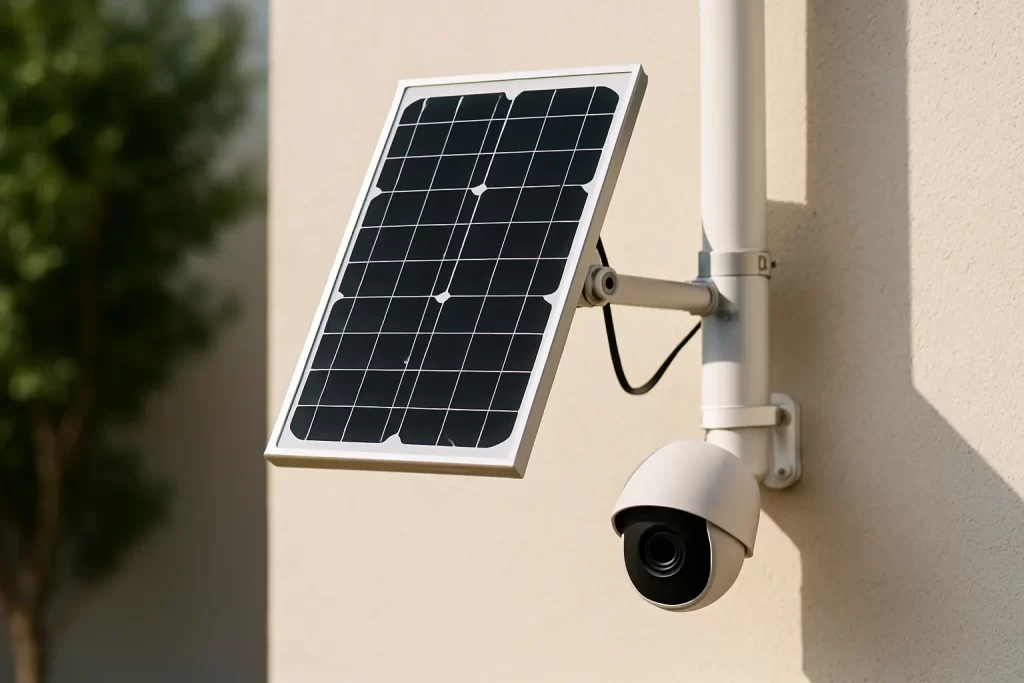
What does a Mono PERC solar panel do and how does it work?
Mono PERC solar panels are monocrystalline photovoltaic panels that add a Passivated Emitter and Rear Cell (PERC) layer to the cell rear, improving light capture and low-light performance so they deliver more usable power in compact form factors for security cameras, IoT sensors, routers and other small off-grid devices.
The PERC acronym stands for Passivated Emitter and Rear Cell; passivation is a thin dielectric layer on the cell rear that reflects unused light back into the cell and reduces recombination (where charge carriers are lost). Monocrystalline indicates the cell material is a single continuous silicon crystal, which provides higher energy density per area than basic polycrystalline cells. The combined Mono + PERC structure increases power output for a given panel area and typically improves late-day and cloudy-condition performance, which matters in constrained mounting locations. Expect a trade-off between the higher per-panel cost of the technology and the space savings or improved uptime it provides when compared with less advanced panels.
Where does a Mono PERC panel fit in Compact Solar product lines and applications?
Compact Solar’s Mono PERC panels fit best in compact, higher-performance applications such as solar panels for security camera brands, trail and wildlife cameras, IoT devices, routers and range extenders, and private-label panels requiring a more consistent daily energy yield.
Compact Solar supplies Mono PERC technology across its small-panel offerings, including USB-C solar panels, Micro-USB panels, DC-output panels, integrated solar panels with built-in battery kits, and panel kits matched to low-power devices. The Mono PERC form factor is particularly useful where panel area is limited but steady electricity is required. Compact Solar supports samples, private-label (white-label) and ODM manufacturing for customers who need custom branding, packaging or volume supply; request guidance on form factor, connector choice and testing when evaluating sample units.
What should you check when specifying a Mono PERC panel?
The specification checklist for a Mono PERC panel focuses on electrical output type, physical size and mounting, charge regulation compatibility and branding or packaging requirements.
Check these items before you specify or order:
- Electrical output type and connector: choose between USB-C, Micro-USB, standard DC output or a panel paired with a battery/charger module to match your device.
- Panel power range and integration: confirm whether you need a standalone panel, a panel with a built-in battery or a full kit with a charge controller and cabling.
- Charge regulation compatibility: confirm the target device or controller accepts the panel’s nominal output; MPPT charge controllers generally extract more energy but are not always required for low-power sensors.
- Mounting and physical envelope: verify panel dimensions, weight and mounting points fit your installation space and mounts.
- Durability and environmental rating: confirm construction and sealing for exposure expected in your deployment (outdoor, sheltered, mobile).
- Branding and packaging options: ask Compact Solar about sample units, logo printing and custom packaging when you plan private-label or OEM supply.
Frequently asked questions
Are Mono PERC panels noticeably better than standard monocrystalline panels?
Mono PERC panels generally provide better light capture and improved low-light response compared with standard monocrystalline cells because the rear passivation layer reflects additional photons back into the cell; the benefit is greater usable power per unit area, at the cost of slightly higher panel price.
Which device types work best with Mono PERC panels?
Mono PERC panels work best with small off-grid devices such as security and trail cameras, outdoor IoT sensors, routers and range extenders, and any compact product where panel area is limited but reliable daily energy is important.
Do Mono PERC panels need a special charge controller?
Mono PERC panels do not require a unique controller type, but you should match the panel’s nominal output to your controller or device input and consider an MPPT controller when you need maximum energy harvest; confirm connector type and any built-in battery pairing during specification.
Contact Compact Solar about your camera, wholesale order or own-brand project.