
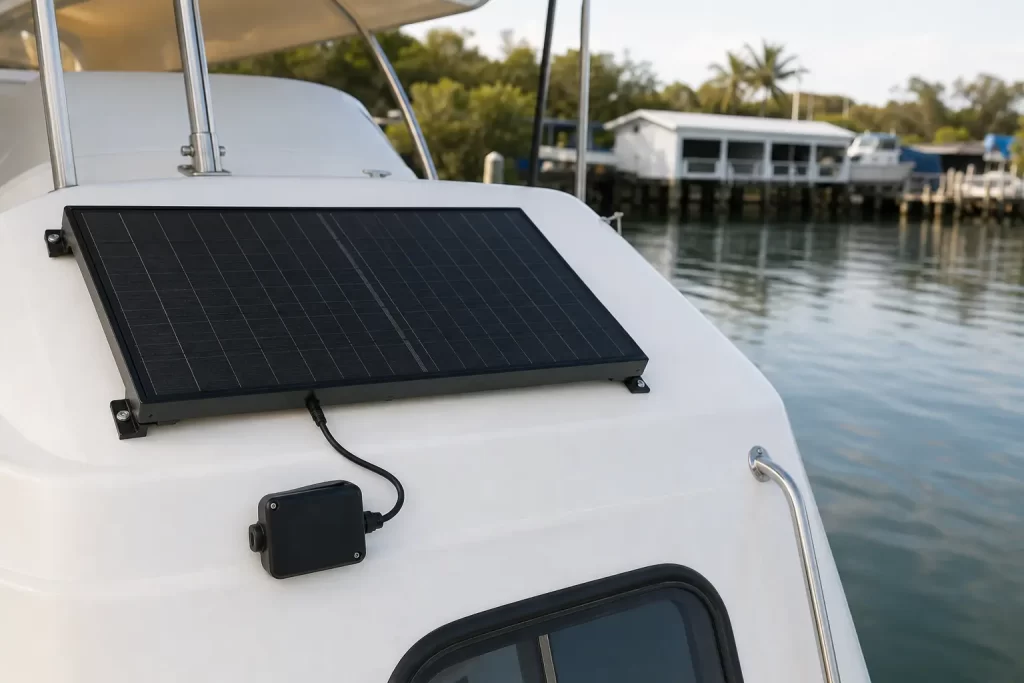
What does a solar battery maintainer do, how does it work and why use one?
A solar battery maintainer keeps lead-acid and compatible lithium batteries topped up from a photovoltaic panel using a low-rate trickle charge and a charge-management circuit to prevent deep discharge, stop reverse current at night, and avoid overcharge, thereby preserving battery life during long idle periods in small solar or IoT installations.
The maintainer uses a trickle charge, where trickle charge means a continuous low current that offsets a battery’s self-discharge, and a charge-management circuit that regulates voltage and current to match the battery chemistry. The charge-management circuit performs three protective actions: it limits charge current to a maintenance level, it provides a float or maintenance mode once voltage reaches the target, and it blocks reverse current from the battery to the panel after sunset. The maintainer is not a bulk charger for rapid recovery; its role is ongoing preservation rather than deep-cycle reconditioning.
Where does a solar battery maintainer fit in a solar power or IoT setup?
The solar battery maintainer fits between the photovoltaic (PV) panel and the battery or the system’s battery-management system (BMS), acting as the charge interface and protective control. The maintainer accepts the panel’s output via common connectors such as USB-C, Micro-USB or DC leads, regulates the charge to match the battery chemistry, and ensures protections like reverse-current blocking and overvoltage prevention. Typical placements include security camera enclosures, outdoor sensor housings, trail-camera rigs, and small communications or networking enclosures where devices draw short bursts of power and rely on a battery to remain ready. When a separate BMS is present, the maintainer hands off capped charging current and respects the BMS’s cut-in/cut-out behaviour so the BMS can perform cell-level protection and balancing.
What should you check before choosing a solar battery maintainer?
Key checks before choosing a solar battery maintainer are battery chemistry compatibility, charge-voltage regulation and connector and enclosure suitability. Verify that the maintainer supports your battery chemistry-lead-acid, AGM, gel or compatible lithium profiles-and that it provides a float/maintenance mode rather than only bulk recharging. Confirm the presence of reverse-current protection and that the maintainer’s charge-voltage and current limits match your battery or BMS cut-in and cut-out settings. Check connector type and wiring: USB-C and DC-output panels are common options, so match the panel’s connector to the maintainer input or plan an adapter. Validate the enclosure rating for outdoor use by checking IP or weather-resistance claims for the maintainer and the panel mounting arrangement. Compact Solar offers integrated panels, USB-C and DC-output panels, panels with built-in batteries and maintainer-ready panels across small wattages suitable for IoT devices; samples, private-label logo printing and custom packaging are available for evaluation and branding where relevant.
Frequently asked questions
Can a solar battery maintainer revive a flat or deeply discharged battery?
A solar battery maintainer cannot reliably revive a deeply discharged or sulfated battery; deep recovery requires a dedicated charger or specialist service designed for battery rehabilitation.
Will a maintainer work with lithium batteries?
A maintainer will work with lithium batteries only when the device explicitly supports lithium charge parameters and safety limits; check that the maintainer’s charge-voltage, current limits and any interaction with your BMS are compatible with the specific lithium chemistry used.
How do I match a solar panel to a maintainer?
Match the panel’s nominal output type and connector to the maintainer’s input and ensure the panel’s open-circuit and operating behaviour falls within the maintainer’s accepted input range rather than relying on wattage alone; use USB-C, Micro-USB or DC-output panels that conform to the maintainer’s requirements.
Contact Compact Solar about your camera, wholesale order or own-brand project.